How to use this guide
Read each section in order. Each idea is followed by examples and a short explanation of why the method works. If you are new to vectors, do not rush. Try the quick checks before moving on.
1. Vectors and scalars
A vector is a quantity with both magnitude and direction. A scalar has magnitude only.
Examples of scalars
- Mass
- Length
- Area
- Temperature
- Speed
- Time
Examples of vectors
- Displacement
- Velocity
- Force
- Acceleration
- Translation
If a triangle is translated 4 units to the right and 2 units up, we can describe that movement by a vector. The vector contains both pieces of information: the size of the movement and its direction.
Test your Vector Knowledge
Ready to practice what you have learned? Take a short quiz and check your understanding.
2. Column vectors
In two dimensions, a vector is often written as a column vector:
The top entry shows horizontal movement. The bottom entry shows vertical movement.
Interpretation
- x > 0: move right
- x < 0: move left
- y > 0: move up
- y < 0: move down
Example
means move 4 units right and 2 units up.
Displacement from one point to another
\[\text{If point A moves to point B, then the vector from A to B is written as } \overrightarrow{AB} \text{. If A = (1, 3) and B = (5, 1), then:}\]
\[\text{ This means that to get from A to B, move 4 units right and 2 units down.}\]
3. Magnitude of a vector
The length of a vector is called its magnitude or modulus.
This comes from Pythagoras' Theorem. The horizontal and vertical parts form the legs of a right-angled triangle.
Worked example
\[\text{ Find the magnitude of} \begin{pmatrix} -3 \\ 2 \end{pmatrix}\].
Step 1: Square each component.
Step 2: Add them.
Step 3: Take the square root.
4. Vector operations
4.1 Adding vectors
Add corresponding components.
Example:
4.2 Subtracting vectors
Again, subtract corresponding components.
4.3 Multiplying by a scalar
Multiply every component by the scalar.
Example:
4.4 Reverse vectors
Reversing the direction of a vector changes its sign.
4.5 Linking points
If you move from A to B, then B to C, the combined movement is from A to C.
5. Position vectors
\[\text{ A vector drawn from the origin O to a point is called a } \textbf{ position vector }\].
\[\text{ This means the point A has coordinates (x, y).}\]
Worked example
Let A = (3, 1) and B = (-1, -2).
To find \[\overrightarrow{AB}\] subtract the position vectors:
Then the magnitude is:
6. Vectors in geometry
Vectors are powerful in geometry because they help us describe parallel lines, midpoints, diagonals, and shapes such as triangles and parallelograms.
6.1 Parallelograms
In a parallelogram, opposite sides are equal and parallel. If \[\overrightarrow{AB} = \mathbf{b} \text{ and } \overrightarrow{AD} = \mathbf{d}\] then:
So the diagonal AC can be written as:
6.2 Midpoints
If M is the midpoint of a segment, then the vector to M is half of the full vector.
6.3 Collinearity
Points are collinear if one vector is a scalar multiple of another. For example, if
then \[\overrightarrow{AP} \text{ and } \overrightarrow{AQ}\] are in the same direction, so A , P, and Q lie on the same straight line.
6.4 A beginner-friendly geometry example
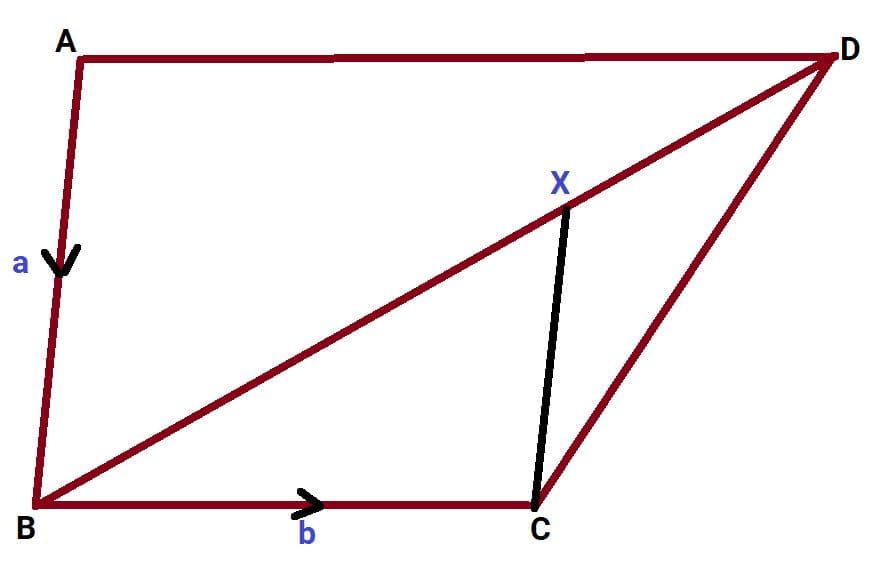
In a parallelogram ABCS, let \[\overrightarrow{AB}=\mathbf{b} \text{ and } \overrightarrow{AD}=\mathbf{d} \text{. If X is the midpoint of BC, find } \overrightarrow{AX} \]
Step 1: Since opposite sides of a parallelogram are equal,
Step 2: Because \(X\) is the midpoint of \(BC\),
Step 3: Now add the route from \(A\) to \(B\) and from \(B\) to \(X\):
7. Common mistakes to avoid
Mistake
Confusing speed and velocity.
Fix
Speed is scalar. Velocity includes direction, so it is a vector.
Mistake
Subtracting coordinates in the wrong order.
Fix
For \[\overrightarrow{AB} \text{, always = } (B - A), not (A - B)\].
Mistake
Forgetting that reversing a vector changes the sign.
Fix
\[\overrightarrow{BA} = -\overrightarrow{AB}\].
Mistake
Adding magnitudes instead of components.
Fix
Add vectors component by component.
8. Try these
Try these questions. Click the button to reveal the answers.
- Is temperature a vector or a scalar ?
- What is \[\begin{pmatrix} 2 \\ -3 \end{pmatrix} + \begin{pmatrix} 5 \\ 4 \end{pmatrix} = ?\]
- Find the magnitude of \[\begin{pmatrix} 6 \\ 8 \end{pmatrix}\].
- If \[\overrightarrow{OA}=\begin{pmatrix}1\\2\end{pmatrix} \text{and } \overrightarrow{OB}=\begin{pmatrix}4\\7\end{pmatrix}\], find \[\overrightarrow{AB}\].
9. Practice tasks
Basic practice
- Classify each quantity as vector or scalar: time, force, speed, displacement.
- Find \[\overrightarrow{AB} \text{ if A=(2,1) and B=(7,-3)}\].
- Find the magnitude of \[\begin{pmatrix} -5 \\ 12 \end{pmatrix}\].
- Given \[\mathbf{a}=\begin{pmatrix}4\\7\end{pmatrix} \text{ and } \mathbf{b}=\begin{pmatrix}-3\\5\end{pmatrix} \text{,find }\mathbf{a}+\mathbf{b} \text{, } \mathbf{a}-\mathbf{b} \text{, and } 2\mathbf{a}\].
Geometry practice
- In parallelogram ABCD, \[\text{ if } \overrightarrow{AB}=\mathbf{b} \text{ and } \overrightarrow{AD}=\mathbf{d} \text{ , write } \overrightarrow{AC}\].
- If M is the midpoint of AB, \[\text{ write } \overrightarrow{AM} \text{ in terms of } \overrightarrow{AB}\].
- If \[\overrightarrow{PQ}= \begin{pmatrix}2\\6\end{pmatrix} \text{ and } \overrightarrow{PR}= \begin{pmatrix}1\\3\end{pmatrix} \text{ , explain why P, Q, and R are collinear.}\]
10. Formula sheet
Vectors Interactive Quiz
Answer the questions. Correct answers trigger a Bravo modal. At the end, review worked solutions.
Question 1: Vectors or Scalars
Classify each quantity as a vector or a scalar.
Question 2: Position Vectors
Given:
- \[\vec{OA}=\begin{pmatrix}3\\2\end{pmatrix}\]
- \[\vec{OB}=\begin{pmatrix}5\\-2\end{pmatrix}\]
- \[\vec{AC}=\begin{pmatrix}-3\\2\end{pmatrix}\]
- \[\vec{BD}=\begin{pmatrix}-2\\-2\end{pmatrix}\]
- \[\vec{CE}=\begin{pmatrix}-4\\-1\end{pmatrix}\]
- \[\vec{DF}=\begin{pmatrix}1\\4\end{pmatrix}\]
Find \[\overrightarrow{EF}\] as a column vector.
Question 3: Vector Operations
Let \[\vec{a}=\begin{pmatrix}4\\7\end{pmatrix}\], \[\vec{b}=\begin{pmatrix}3\\-5\end{pmatrix}\], \[\vec{c}=\begin{pmatrix}0\\4\end{pmatrix}\]
Question 4: Parallelogram ABCD
In the parallelogram \[\textbf{ABCD , } \vec{AD}=\mathbf{d} \text{ and } \vec{AB}=\mathbf{b}\]. The point X is the midpoint of AB. The lines AC and DX intersect at Q.
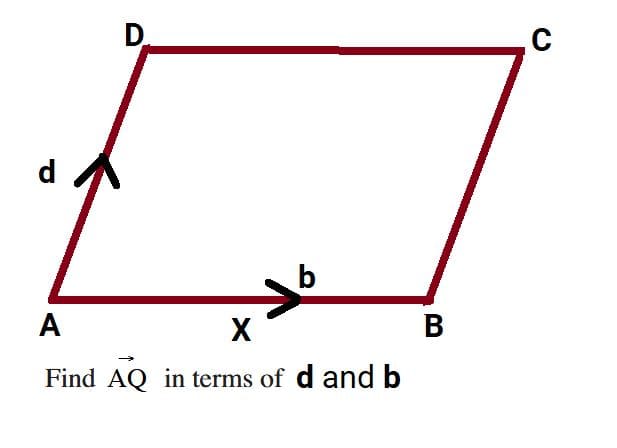
Find \[\vec{AQ}\] in terms of \[\mathbf{a} \textbf{ and }\mathbf{b}\].
Question 5: Parallelogram OABC
\(OABC\) is a parallelogram.
\[ \vec{OA}=3\mathbf{p}-2\mathbf{q} \] \[ \vec{OC}=5\mathbf{p}+6\mathbf{q} \]
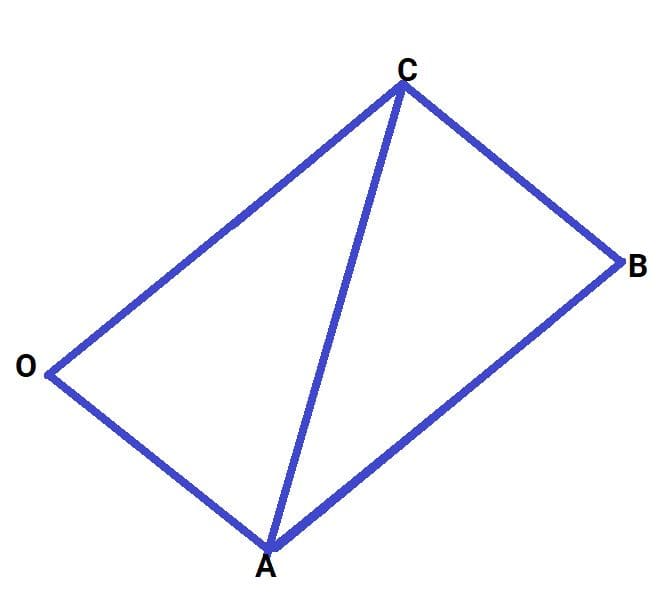
(a) Find \[\vec{AC}\].
Express your answer as simply as possible in terms of \[\mathbf{p} \text{ and } \mathbf{q}\].
(b) D is the point where \[\vec{BD}=-2\mathbf{p}+6\mathbf{q}\]. Using vector methods, show that D lies on the line AC produced.
Question 6: KLMN is a parallelogram
KLMN is a parallelogram with position vectors
\[ \vec{OK}=\begin{pmatrix}2\\-3\end{pmatrix},\quad \vec{OL}=\begin{pmatrix}6\\-3\end{pmatrix},\quad \vec{ON}=\begin{pmatrix}3\\5\end{pmatrix} \]
The point H lies on KM such that KH = HM
Question 7: ABCD is a quadrilateral
ABCD is a quadrilateral, not drawn to scale, with \[\vec{AB}=\mathbf{a} \text{ ,} \vec{BC}=\mathbf{b} \text{ and } \vec{AD}=2\vec{BC}\].
The point X divides BD in the ratio 3:2.