
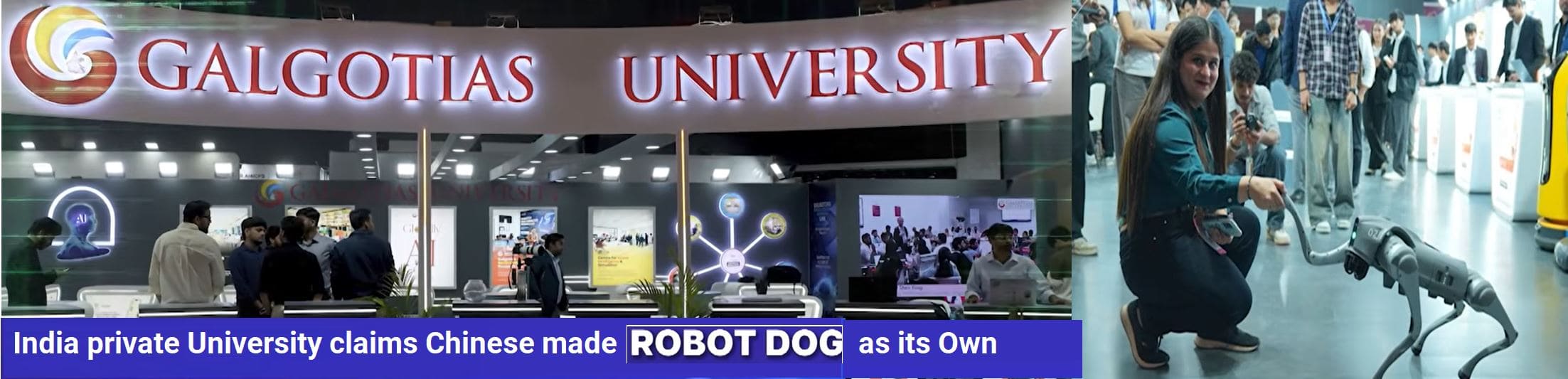
The Unitree GO2—a true marvel of robotics-How an Indian private university hijacked this innovation
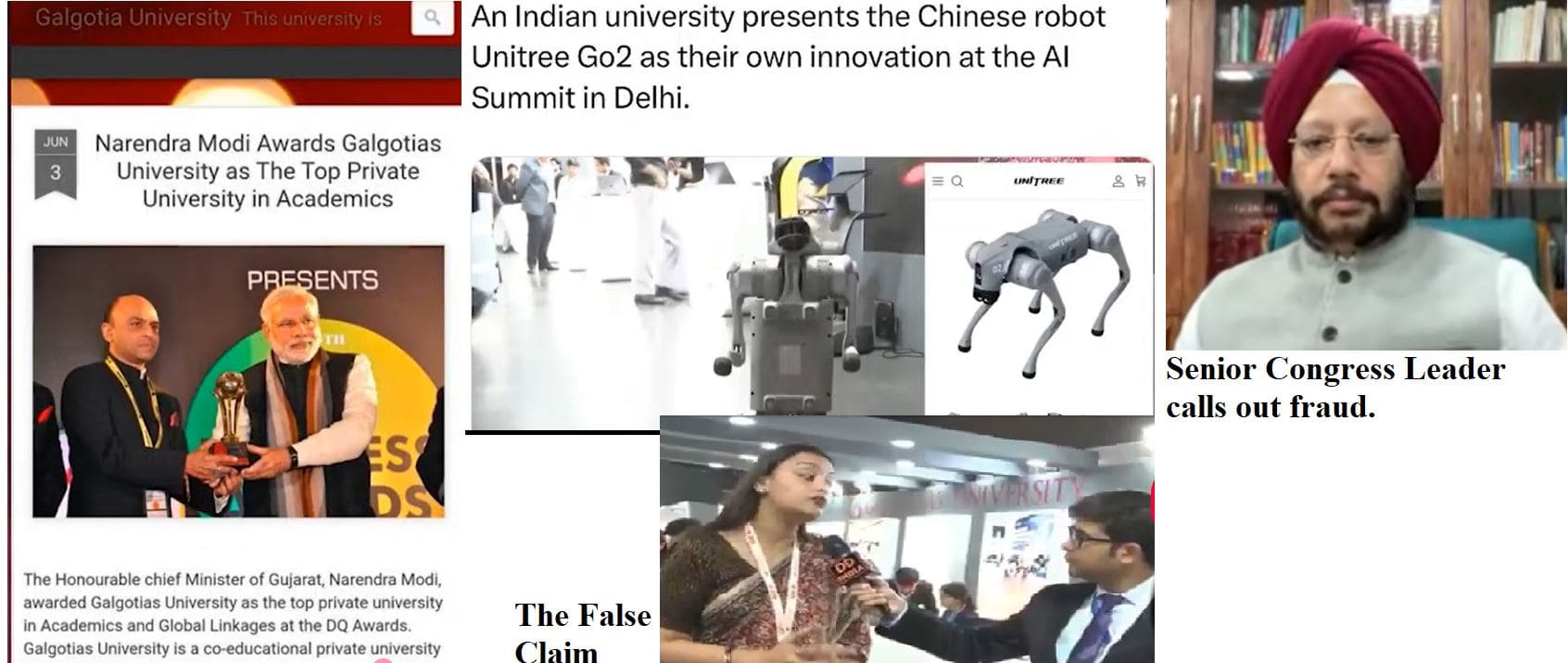
The Unitree GO2—a true marvel of robotics—has redefined what we expect from robotic companions. Designed and developed by Unitree Robotics, the GO2 is not just any robot. It’s a cutting-edge, Chinese-made robotic dog that combines advanced AI, dynamic movement, and agile design. Unlike anything the world has seen before, the GO2 is capable of performing complex tasks, navigating various terrains, and even offering assistance in real-world applications like search and rescue or surveillance. With its incredible speed, precision, and natural movement, it stands as a testament to what robotics can achieve in the modern world. But instead of celebrating such technological triumphs, one Indian institution has found itself embroiled in a massive controversy. Galgotia University has become a global embarrassment at the AI Impact Summit 2026 after one of its professors was caught falsely presenting a Chinese-made robo dog. In a clip that has gone viral, DJ News correspondent was seen asking questions to Professor Niha Singh, who boldly claimed that the robo dog was developed at the Center for Excellence at Galgotia University. But in a dramatic turn of events, just minutes later, Chinese media called out the claim, exposing the robot for what it truly was: the Unitree GO2, a Chinese-made product. That’s when the story of shame spiraled out of control. The robo dog wasn’t just misrepresented—it was stolen from the global technological stage and falsely attributed to the university.
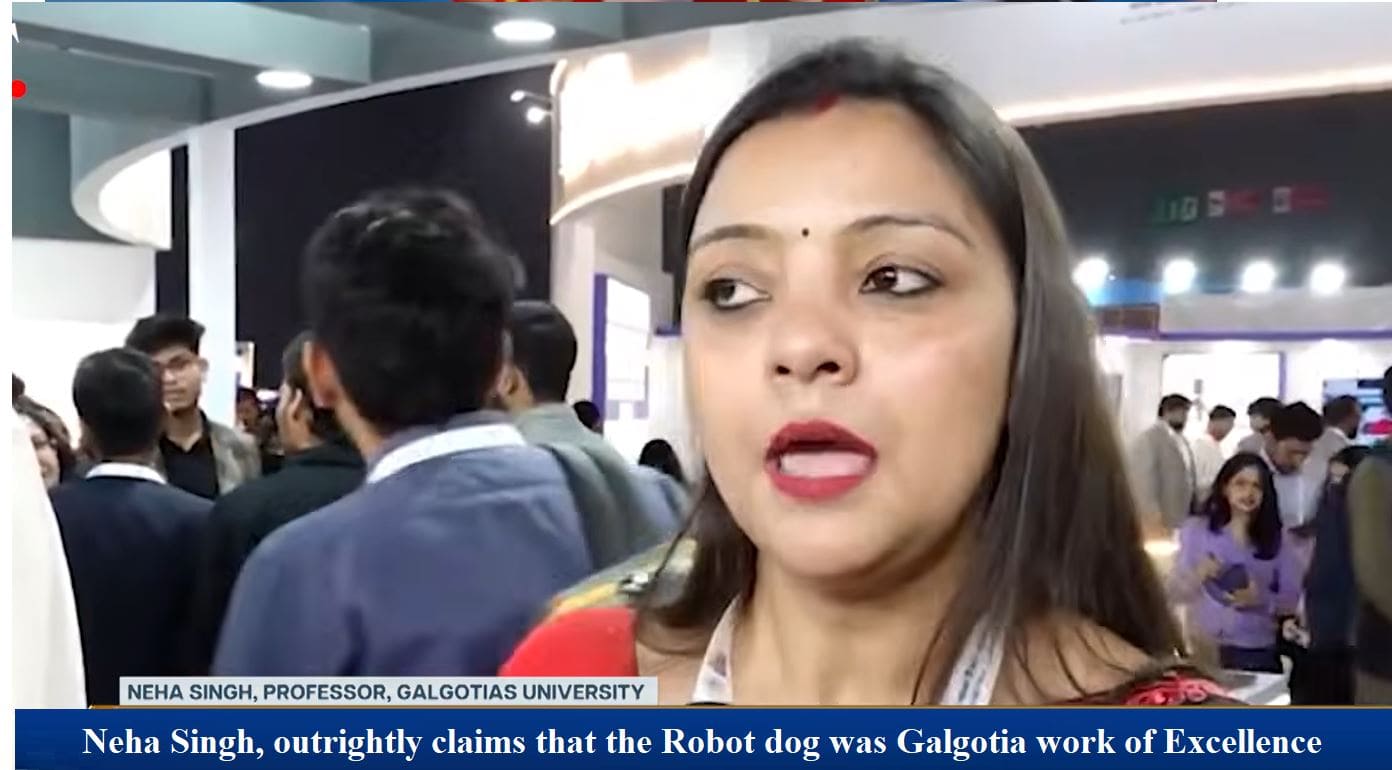
Deception that sclaes beyong academic integrity
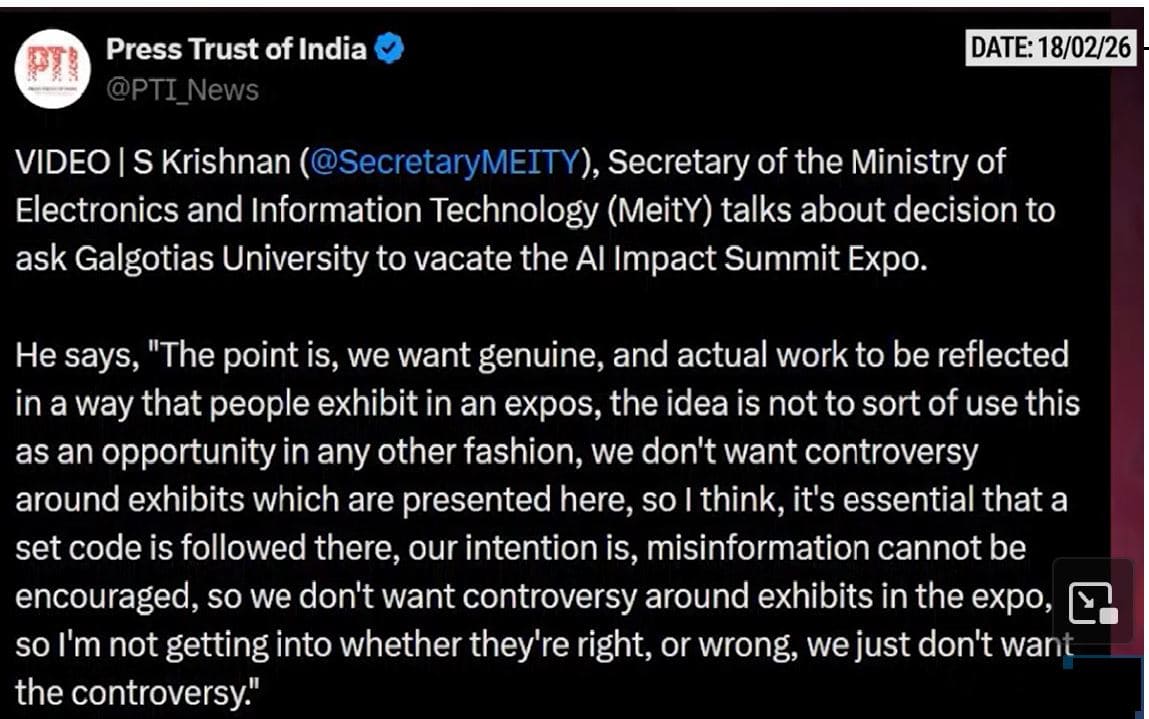
This wasn’t just an academic misstep—it was a blatant deception that shook the credibility of India private Universities to its core. What was even more heartening is the fact when Krishnan S, Secretary of Ministry of Electronics and Information Technology, was asked to comment on the act of fraud by the Galgotia University, he answered, saying that he doesn’t want to get into the controversy. He doesn’t want to discuss whether the university was right or wrong. What does this attitude really indicate? What was supposed to be a prestigious AI summit turned into a global embarrassment and Krishnan S, merely says he has nothing to say. When asked about the double-sided stance of the Ministry of Information Technology, senior Congress leader and CWC member Mr. Gurib Sappal responded with unwavering conviction: "This is much more serious than it appears." He didn’t mince words, exposing the shocking truth behind the Galgotia University debacle—it’s not just one careless error or a single misrepresentation by the university. No, this points to something far deeper, something far more insidious plaguing the very core of India’s scientific and technological development.
Fradulent deception by Galgotia is just a tip of system rot-Mr. Sappal
Galgotia University, he argued, is merely the tip of the iceberg. What seems like an isolated case is in fact a symptom of a much larger systemic rot. Yes, the university bought a robo dog from the Chinese market and presented it as their own—that’s one thing. But the true outrage lies in the larger issue at play: What does this say about our entire academic and innovation landscape? The statistics, Mr. Sappal pointed out, are staggering. In 2022-23, Indian companies filed an impressive 7,700 patents on average. Yet, Galgotia University, one of the leading names in higher education, filed a staggering 1,089 patents. But here’s the bombshell: Out of these 1,089 applications, Galgotia was granted zero patents. Zero! This is not just a minor mistake or an academic oversight—it’s a massive scam, a dangerous façade that has been passed off as legitimate innovation. But it doesn’t stop with Galgotia. According to Sappal, this is a widespread epidemic—numerous private universities are flooding the patent offices with applications that never see the light of day, while only a handful of patents are actually granted. Yet, these institutions continue to claim the title of "centers of excellence", endorsed by ministers and touted by the Ministry of Education as paragons of academic achievement.
The system supports and turns a blink eye-Mr.Sappal
But the truth, as Sappal emphasized, is far darker. These private universities are bluffing their way through, deceiving not only students but the entire nation. They’ve turned innovation into a money-making game, while propagating an image of technological superiority that is nothing more than a sham. The government must confront this issue head-on. Yet, instead of taking a stand, they remain dismissive—as if this debacle is just another minor blip. This was India’s moment, a golden opportunity to showcase our technological brilliance to the world, to prove that we are ready to lead the AI revolution. Yet, what we’re witnessing is a farce, a propaganda spectacle, where juvenile, half-baked projects are paraded around as cutting-edge innovations. Mr. Sappal, continued, this is not just disappointing—it’s an embarrassment of global proportions. The government’s inaction is a betrayal of India’s potential. What we needed was a platform that would ignite awe, showcasing India’s true innovative power. Instead, we’ve been reduced to presenting school-level projects, far from the technological marvels we should be showing off. This AI summit should have been a launchpad for India’s technological future, a moment to stand tall on the global stage. Instead, it has become a humiliating display—one that leaves the world questioning our capabilities. This isn’t just about one university—it’s about the entire educational and research ecosystem that has been compromised, Mr. Sappal, added.




User Comments
@ngpoint4772
Private deemed rogue universities are doing this to get more students enrolled… Galatia is a crime(crown) jewel of those universities 😂😂😂
@yashsvidixit7169
These idiots can't even solve math questions from high school NCERT books and they are talking about AI. 😂😂😂
@PSRao_1712
Most of the claims done by Indian firms are false.. Just take money from Govt, write reports, time lapses, write a closure report and be done with it..
@aki78638
The students of this university and many private universities are totally idiotic.😎
@Rubicon365
At least the patent office sound legit 😂
@Pitambar-M
Next year, Golgotiya University will display i-Phone (any version)/ Samsung(any model) and claim it as their own innovation. If caught, they will say those products were acquired from market for research purpose for their students. 😲
@APCoolX
Sums up Indian Education. Too much noise and no signal. 🤣😅
@Gaia_devi
Yes !...this is one of main reason for students fleeing India to escape from Professors , and private universities who just want only money ... 🙏
@sanjeevshankar9426
The AI wing of this university was inaugurated by Mr Piyush Goyal!! 😂 😎.
@vvvi-t9c
Whats update on that cow dung research? Does anyone know? 🤭🤭🤭
@udaykumar-we3bk
There is no scientific temper in our country. Just religious temper💪👏. 👋🏼
@downrigger8897
What is amazing is that a country that has literally no AI, just jugaad, has its prime minister at an AI summit. At least we could have a summit for what we are good at. Like guspeti summit, statues summit etc.
@Karachi.Zone.Karachi
If Chinese didn't point out whole india would fall for it
@ajaychandak3083
They got permission of a medical college in Jammu revoked. Can they send committee to review A+ rating of the university?
@lisaac4898
Sadly a section of the country think only in their own box... They don't realise others do read and see serious news on various subjects than whatsapp forwards... similarly dressing up and talking two lines of English doesn't put one in the intellectually forward bracket It's time this sort of event is given to South to host ...when in every way we have the capability ( stuff) and the infrastructure...
@sparunachalam5669
We all know very well this government is run by propagandists headed by an attention seeking specialist
@Subhash_1987
R-S-S(B-J-P) doomed India, there is nothing left!! 😢😢😢 .
@squ34ky
This is a sure sign that maybe we need to be more modest in our goals... fix the basics like hygiene, poor infrastructure, lack of civic sense, corruption before trying to project our technical or scientific prowess. 😊 Thank you! ❤️