
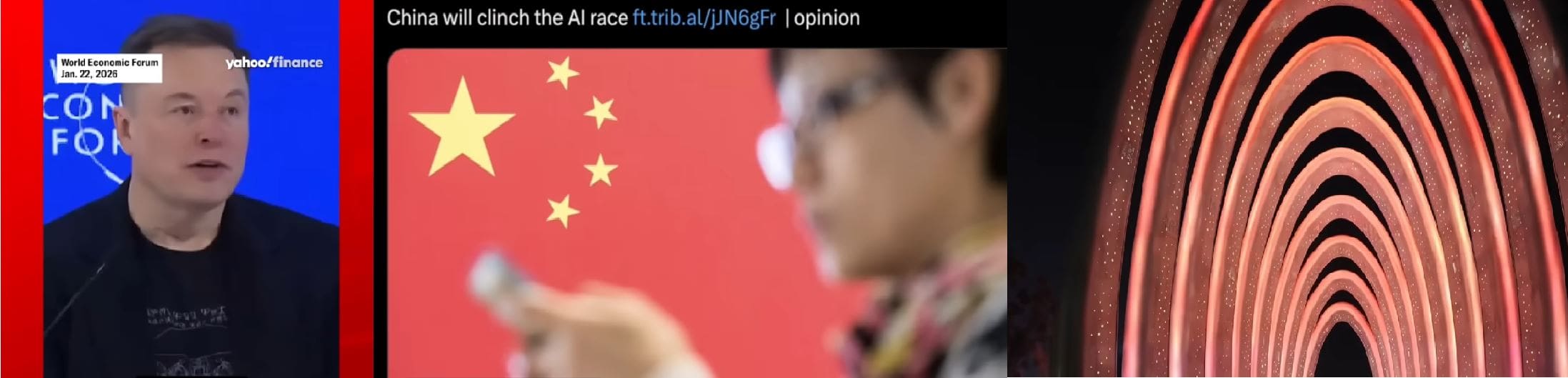
China is miles ahead in AI race
China will clinch the AI race. That’s not speculation. That’s not nationalism. That’s not wishful thinking. That is the headline from the Financial Times. For years, we were told a different story — that the United States was untouchable in artificial intelligence, that Silicon Valley had an insurmountable lead, that the rest of the world was merely chasing shadows. The narrative was clear, confident, and repeated so often it became doctrine. But reality has a way of exposing comfortable illusions. Because on the ground — in factories, in data centers, in research labs, and across entire industrial ecosystems — a very different story is unfolding.
Today, we’re not here to debate whether China might win the AI race. We’re here to examine why the shift is already underway. We’re going to break down the evidence, react to the clips, and expose the structural advantages driving this transformation — advantages hiding in plain sight. And perhaps most revealing of all, these are the very factors that high-profile voices — from former Google CEO Eric Schmidt to Palantir’s Alex Karp — either underestimated or completely overlooked. This isn’t about hype anymore. It’s about momentum. And momentum, once built, is very hard to stop.
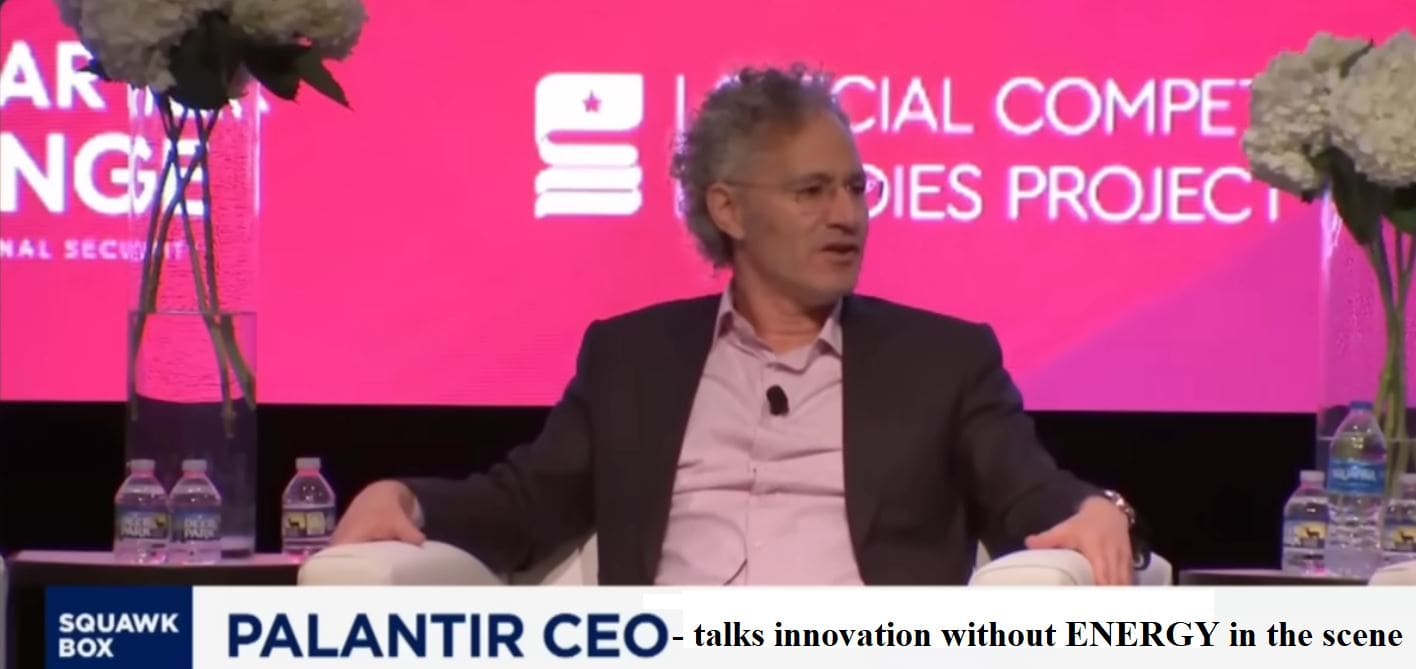
The Energy Advantage Nobody Talks About
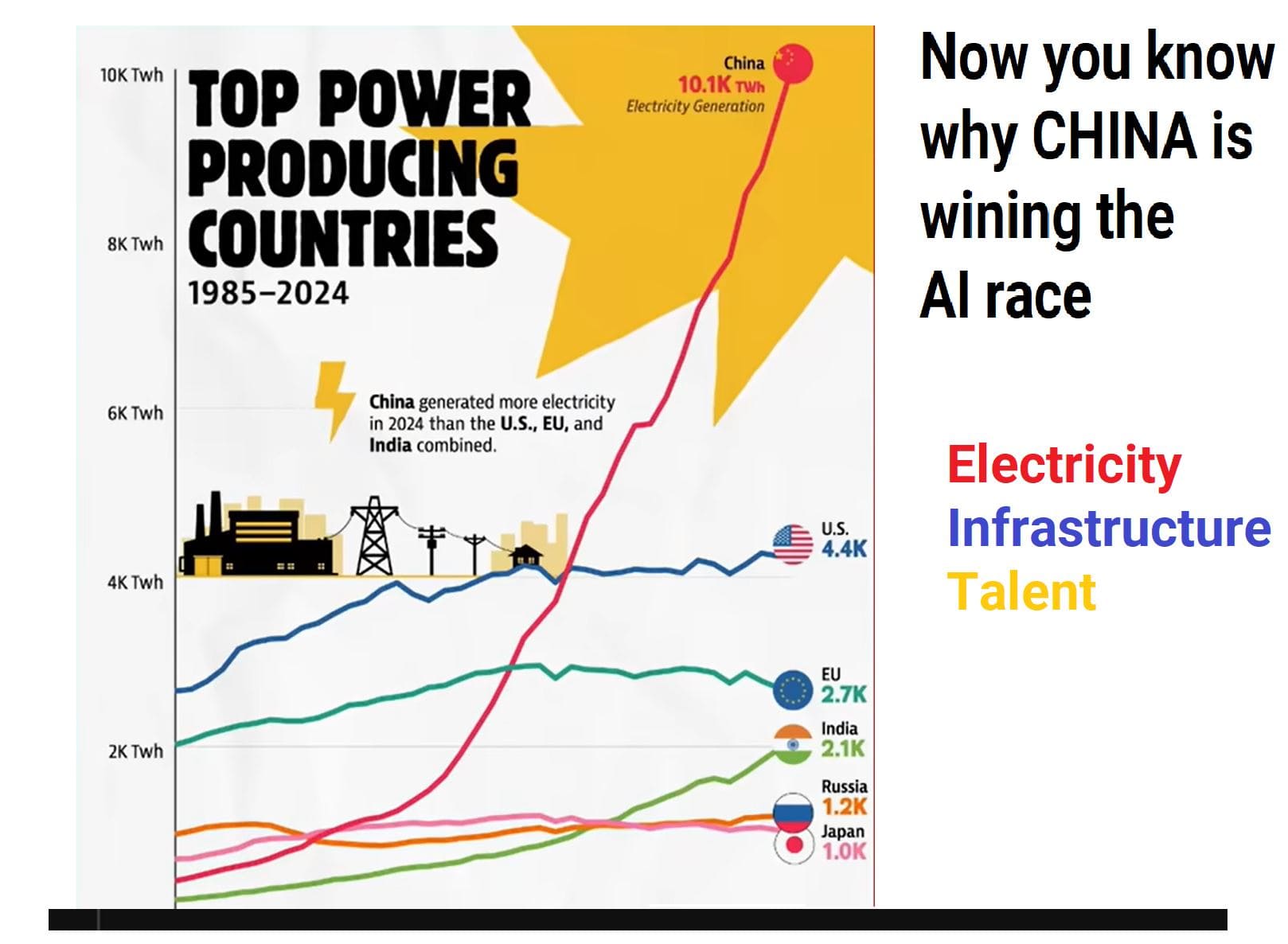
Momentum does not materialize out of thin air. It must be powered. And in the AI race, that power is not symbolic — it is literal. Strip away the headlines, the model benchmarks, and the boardroom bravado, and you arrive at the fundamental driver of artificial intelligence: electricity. Raw. Scalable. Abundant energy. This is the advantage few are willing to confront. Because while the West debates algorithms and venture capital, China has been building the foundation that makes large-scale AI dominance possible — energy infrastructure at staggering scale.
China’s growth in electricity is nothing short of extraordinary. Solar is no longer an auxiliary source; it is becoming the backbone of national industrial expansion. With production capacity reaching roughly 1,500 gigawatts per year and more than 1,000 gigawatts deployed annually, China is adding energy at volumes that redefine global benchmarks. For perspective, average US power usage stands at around 500 gigawatts — meaning China’s annual solar deployment alone rivals half of America’s entire consumption. Manufactured at remarkably low cost and integrated with battery storage, this energy surge fuels data centers, factories, and AI training clusters at a scale others struggle to match. While companies like SpaceX and Tesla aim to build 100 gigawatts of solar manufacturing capacity annually in the US over several years, China is already operating at magnitudes beyond that. In a world where AI runs on computation — and computation runs on electricity — energy abundance becomes the ultimate strategic weapon.

China’s Practical AI vs. The West’s Venture Capital Spiral
Before we even compare models or markets, we need to confront an uncomfortable reality: a growing wave of anti-AI sentiment in the United States. When reports surfaced that OpenAI had canceled planned data centers, the reaction in many corners of social media was not concern — it was celebration. A frenzy. A collective sigh of relief. For some, the potential slowdown of AI development felt like vindication. But beneath that reaction lies a deeper issue. AI is not “taking” jobs in some mechanical sweep; disruption has always accompanied technological progress. What threatens workers most is not automation itself, but resistance to adaptation — the unwillingness to upskill, to retrain, to evolve with the tools shaping the modern economy. Instead of confronting that challenge, segments of the public cheer setbacks, mistaking temporary turbulence for systemic failure. While energy is spent debating whether AI is useless, other nations are treating it as inevitable — and strategic.
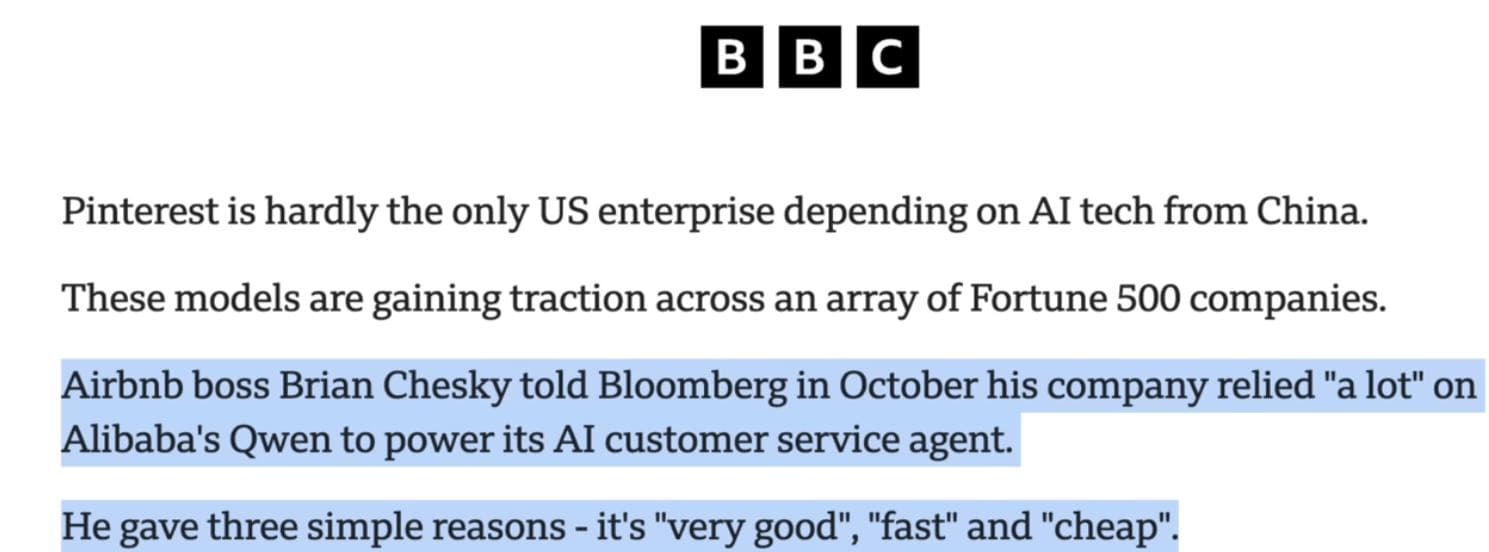
And this is where the divergence becomes stark. While some in the West celebrate canceled data centers and question the viability of AI altogether, China is quietly constructing a different model — one grounded not in hype, but in execution. The Western AI surge was fueled heavily by venture capital and expensive proprietary systems chasing rapid monetization. In contrast, Chinese laboratories are releasing open-source models such as DeepSeek and Alibaba’s Qwen — systems reported to be dramatically cheaper and highly efficient. American firms like Pinterest and Airbnb are already integrating Chinese AI solutions, not out of ideology, but practicality. While Western companies remain tethered to investor expectations and quarterly profitability pressures, China prioritizes utility, scalability, and national deployment. The result is not a speculative bubble, but an ecosystem engineered for mass adoption — built to function at industrial scale rather than to impress venture capital spreadsheets.

Infrastructure, Talent, and Scale
China’s advantage does not rest on a single breakthrough or a single company. It stands on three formidable pillars: electricity, infrastructure, and talent. Electricity is the bloodstream of the AI age. Just as the industrial revolution was powered by steam and the digital revolution by silicon, the AI revolution runs on energy — relentless, scalable, and abundant. In many ways, artificial intelligence is the new electricity, but electricity remains its lifeblood. And China has understood this with strategic clarity. Massive investments in renewable generation, grid expansion, and energy storage are not environmental gestures alone — they are geopolitical positioning. They ensure that when computation scales, the power to sustain it already exists.
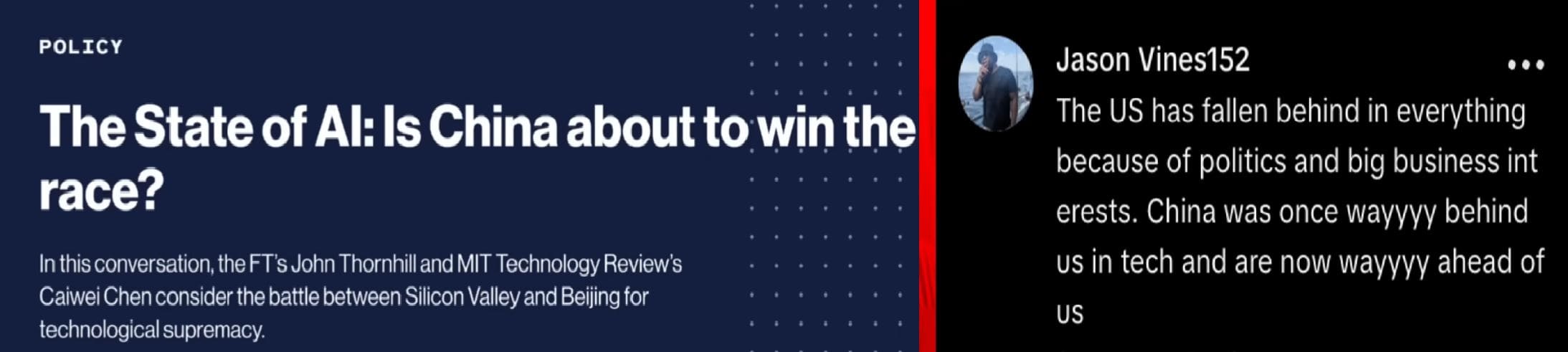
Then comes talent — the silent multiplier. China now leads the world in AI research output and citations, shaping not only domestic innovation but global academic discourse. In 2023 alone, it accounted for roughly 70% of global AI patents, a staggering signal of momentum and intellectual concentration. The AI industry itself is valued at approximately $170 billion, powered by thousands of enterprises operating within a coordinated national strategy that aims to integrate AI into nearly every sector of the economy by 2030. This is not accidental growth. It is deliberate scaling. Infrastructure to support it. Energy to fuel it. Talent to drive it. When these forces converge, the result is not incremental progress — it is systemic acceleration.
Also read thisInfrastructure, Talent, and Scale
China’s advantage does not rest on a single breakthrough or a single company. It stands on three formidable pillars: electricity, infrastructure, and talent. Electricity is the bloodstream of the AI age. Just as the industrial revolution was powered by steam and the digital revolution by silicon, the AI revolution runs on energy — relentless, scalable, and abundant. In many ways, artificial intelligence is the new electricity, but electricity remains its lifeblood. And China has understood this with strategic clarity. Massive investments in renewable generation, grid expansion, and energy storage are not environmental gestures alone — they are geopolitical positioning. They ensure that when computation scales, the power to sustain it already exists.
Then comes talent — the silent multiplier. China now leads the world in AI research output and citations, shaping not only domestic innovation but global academic discourse. In 2023 alone, it accounted for roughly 70% of global AI patents, a staggering signal of momentum and intellectual concentration. The AI industry itself is valued at approximately $170 billion, powered by thousands of enterprises operating within a coordinated national strategy that aims to integrate AI into nearly every sector of the economy by 2030. This is not accidental growth. It is deliberate scaling. Infrastructure to support it. Energy to fuel it. Talent to drive it. When these forces converge, the result is not incremental progress — it is systemic acceleration.

User Comments
@SuhandiWijaya
China is winning in every aspect, and Murica only wins in the propaganda machine
@dokinglife
China already won few years ago and its the no.1 economy now... China is just being polite and do not like boasting about it
@Mastermerlin-j5f
China is the future - China creates, the US destroys.
@RedSunriseOnTheHorizon
That palantir ceo is constantly in a cocaine induced psychosis
@brainites
"Losers focus on winners. Winners focus on winning".
@taiwanstillisntacountry
Does the West has enough electricity? 😂😂😂😂😂😂😂😂😂 The USA aka IOU-country doesn't even have an updated electricity grid.
@bluegamer4210
Communism is the real democracy. Thank you! 🙏
@davefroman4700
NMoore's law is not dead. A new technology is already emerging that will replace electronics. Photonics. China already has the worlds first quantum photonic processor. 😎.
@62gkm
China silently conquering everything and they deserve unlike "so called self styled super powers"! Thank you! 🙏 for another great report!
@krnjpnpowr
China graduated 1.6M engineers in 2025. The US graduated 160K. It's obvious who will have the advantage in the future. 👋🏼
@SoF1ngwhat
The US laid off millions of people just to get further embarrassed huh? No surprise, then. The clown show continues.
@marlbankian
Excellent analysis site. Thank you! 😊 Thank you! ❤️