
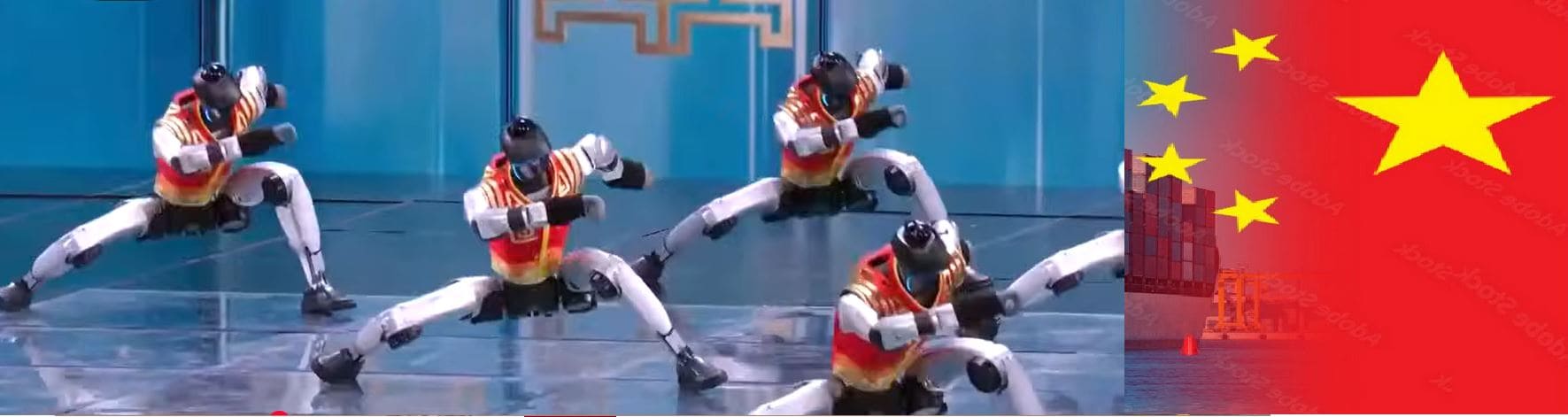
Is China leading the world on AI? Are they in front?
The utmost vital question that ought to be answered so the world knows who is really leading the AI Tech innovation. The following is the presentation report of AI Tech journalists who tirelessly research, compare, coordinate on anything that involves AI development, from appreciation to critism. This is the update on 12 months development of humanoid robots, which went from from a struggling old man with soiled pants trying to navigate his way out to a Bruce Lee level martial arts expertise.
How CNN fools people with its Cope mechanism
When an unknown Chinese startup burst onto the global stage in 2025 with a powerful AI model named Deep Seek, it didn’t just enter the conversation — it shook the foundations of the AI world. Yet, almost immediately, CNN was quick to dismiss it, branding it as the “hype of the year.” A passing storm. A temporary spectacle. Nothing more. But truth be told, Deep Seek was not hype — it was a trigger point. Its arrival ignited a massive AI boom across China. Investors didn’t shrug. Markets didn’t yawn. In the months that followed, six Chinese AI and chip firms raised more than three billion US dollars through IPOs in Hong Kong. Capital moved. Confidence surged. Momentum built. That is not hype — that is market validation. And as the saying goes, “the proof of the pudding is in the eating.” So now the real question stands before us: Does CNN’s dismissal — echoed faithfully by sections of the Australian media — truly hold water? Do those who repeat the comforting mantra, “Don’t worry, they’re still behind us,” speak from evidence… or from denial? Because when capital flows, when deployment accelerates, when ecosystems mobilize — the narrative begins to crack. So let us examine the facts. Let us test the claim. And let us see whether that reassurance still stands — or whether it collapses under the weight of reality.
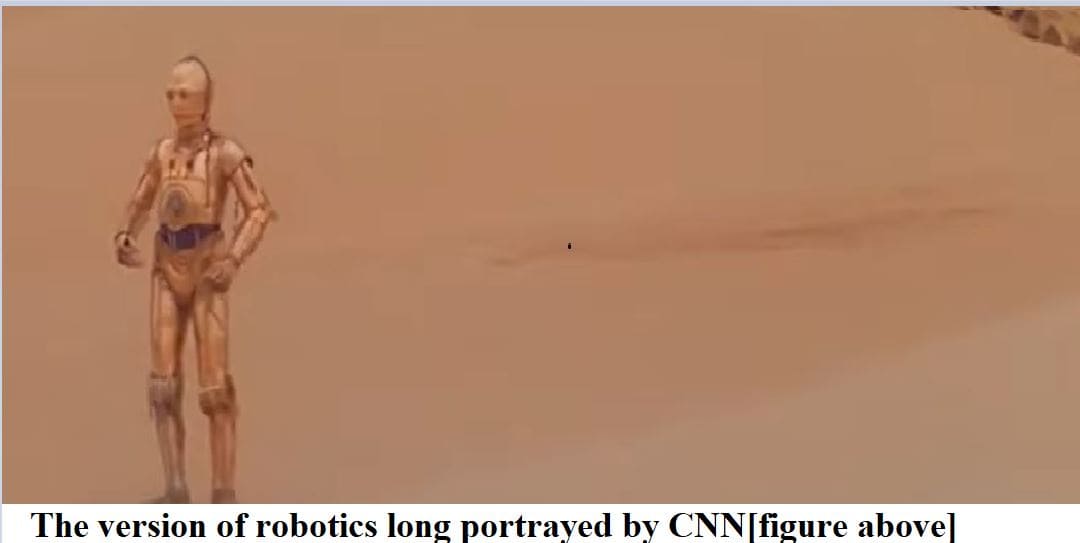
There are two images before you. One is the familiar narrative — the version of robotics long portrayed by CNN and its counterparts: rigid machines, cautious progress, incremental evolution. Manageable. Predictable. Safely behind. The other image is impossible to ignore — kung fu robots performing live at Chunwan, China’s New Year’s Eve megabroadcast, in front of hundreds of millions. They leap. They spin. They balance. They synchronize. Not in a lab. Not in simulation. But on the world’s biggest stage.
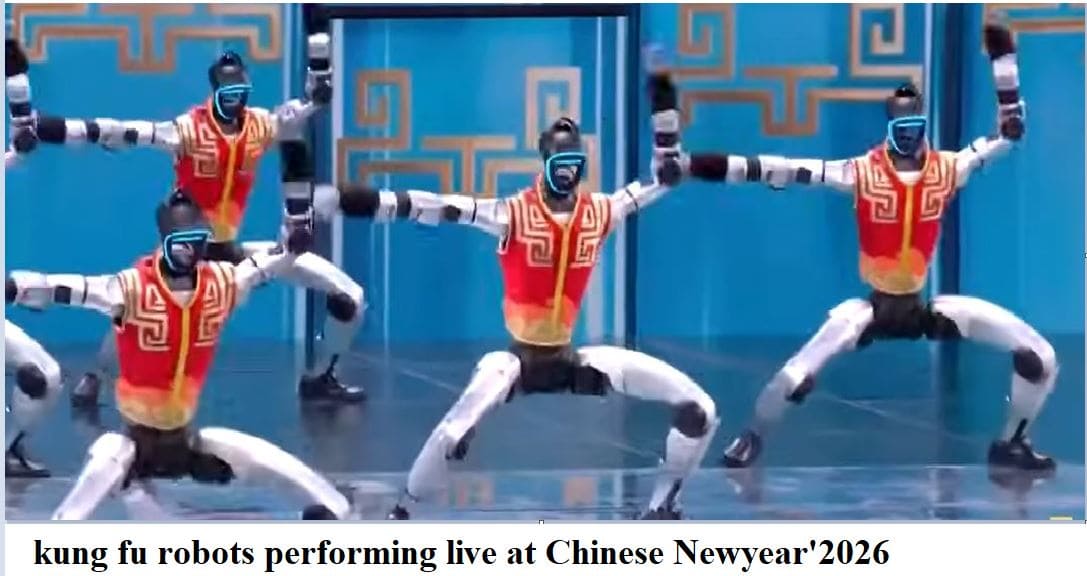
The contrast is staggering. And yet, in a remarkable twist of irony, we are told to ignore what we can see with our own eyes. Ignore the army of humanoid robots executing complex martial arts in perfect rhythm. Ignore the real-world deployment. Instead, we are instructed to focus on a theoretical, invisible gap in AI models — a gap repeatedly emphasized by major Western media outlets. It’s like someone proudly declaring they possess the world’s fastest engine, while their rival is already crossing the finish line in a commercially available car. Theory versus deployment. Promise versus execution. Laboratory metrics versus market reality. So now it’s time to move deeper. It’s time to examine — critically and methodically — the two pillars that CNN and ABC Australia return to again and again: chips and capital. Because if those are the foundations of their argument, then that is precisely where we begin the dismantling.
Debunking the Chip Ban Narrative
Yes, the United States has attempted to restrict China’s access to cutting-edge semiconductor chips. But what actually happened? China adapted. According to IEEE Spectrum, Huawei has released a public roadmap for its Ascend chip series, with the Ascend 950 targeting one petaflop of performance. While these chips may still trail Nvidia’s top-tier offerings on a one-on-one basis, China is compensating through scale by building massive supercomputing clusters such as the Atlas 950 SuperPOD, which will link over 8,000 Ascend chips. Rather than competing chip-for-chip at the highest tier, China is pursuing a system-level strategy — leveraging aggregation, deployment, and industrial scale to offset individual performance gaps and effectively wage a war of technological attrition. Also read this
Debunking the Capital Shortage Narrative
The CNN says that China doesn’t have as much money as American tech giants. On paper, that’s true. US firms are projected to spend hundreds of billions on AI. But this ignores the most important metric: capital efficiency. This means, China does more with less.
A CSIS report on robotics notes that a robotic arm in China costs less than half of what it does in the US. Their factories can produce cars at 20% lower cost through automation. So while the US is throwing money at R&D, China is investing in a manufacturing ecosystem that makes every dollar go further. They are building the machines that build efficient machines that are cheaper and faster than anyone else.
So now you see that the chips and capital argument is a pure cope mechanism. A comforting narrative to hide the fact that China is outmaneuvering the West on the two fronts that actually matters: deployment and efficiency. Though US export controls bar Chinese companies from getting cutting-edge chips, and they don’t have as much money as American tech giants. But truth be told none of these deters China. For the AI frenzy over the past year shows just how fast Chinese companies can advance under mounting pressure. Now, Beijing has made AI a top national priority, showering companies with favorable policy and tens of billions of dollars in investment capital.
These investments have begun to bear frutits, for there are signs that Chinese AI may be winning the race in one key critical area: The Real-life applications. Now there are AI robots that specializes in ordering and delivering groceries on your behalf to assembling cars all without the intervention of humans. These humanoid robots are being developed to take over factory floors and household duties — scenarios that could ultimately determine the future of the AI race.
Adding Salt to their own wounds
To add salt to the wound, ABC Australia brought in John McCormack, Director of the Centre for Transformative Media at Swinburne University, and posed the question many skeptics were quietly asking: was it fake? His response was immediate and unequivocal — “No, it’s not fake. It’s incredible.” He underscored that the level of physical capability achieved in such a short span of time was extraordinary.
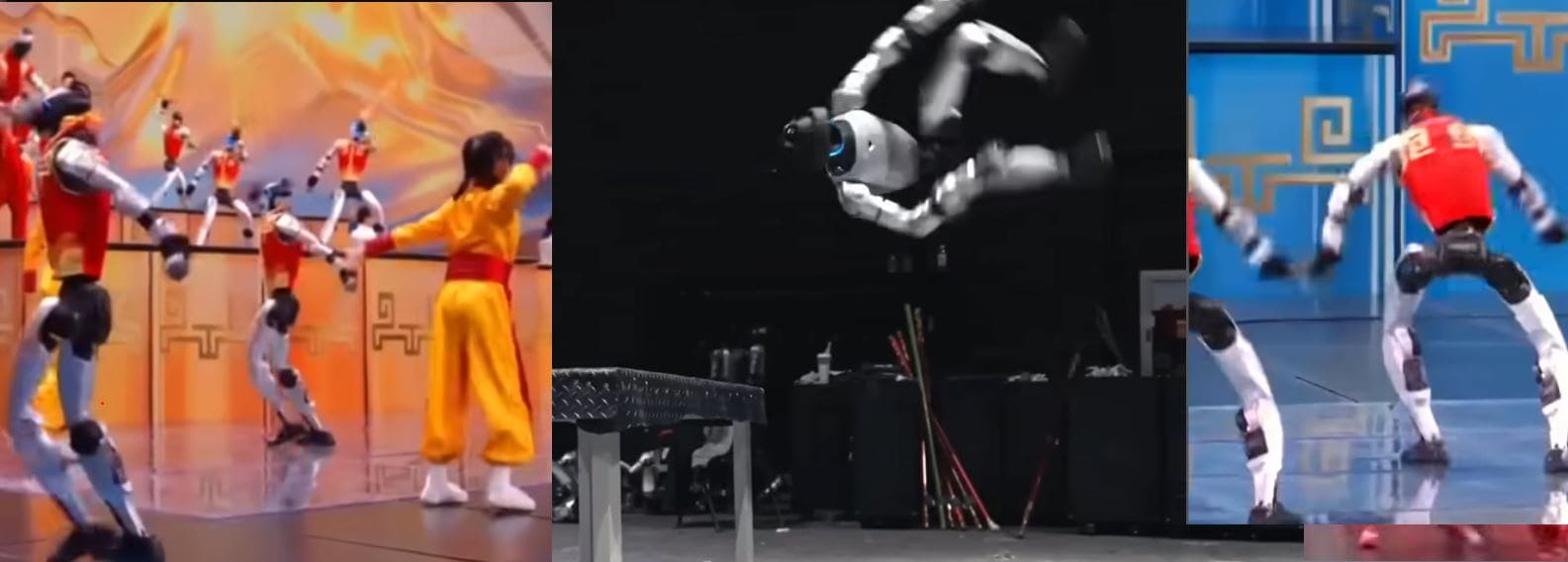
He explained that these robots are trained using advanced machine learning and motion capture, where a kung fu master’s movements are meticulously recorded and fed into training systems, enabling the robots to absorb and replicate human motion with striking precision. Depending on complexity, such training can take anywhere from a single day to a week — a pace that reflects just how rapidly robotic learning is accelerating.
While still seeking reassurance, the reporter pressed further, asking whether China is leading the world in this domain. McCormack did not hesitate: they are at the front. While companies in the United States, Europe, Japan, and Korea are conducting similar research, the critical difference lies in accessibility — Chinese humanoid robots are commercially available. They are not confined to laboratories or hidden behind corporate walls; they can be purchased, deployed, and tested in the real world. In much of the West, humanoid robotics remains largely experimental and out of public reach. In China, it has already stepped beyond research facilities and into society — and that transition from prototype to product may be the most telling development of all.
So what is the take back from this?
While, Western media claims China is behind, yet their own reporters and professors acknowledge China is leading in real-world deployment. Most times with their focus being merely on theoretical gaps while ignoring visible market penetration. Thus the ground reality always contradict their narrative. In conclusion, John from Swinburne University goes on to add that, China is leading the socialization of these robots by putting them in public spaces under scrutiny and that is not propaganda. That is market leadership.




User Comments
@marym-w2e
At this point to compare china to america is an insult to china....
@MonoYuki
I hope China keeps their robot technology safe from the greedy and warmongering west.
@Jili-r1b
As an Australian I am embarrassed by our media. Its so stupid they ask a Professor for "transformative media" rather an expert in robotics. Why don't they just have a football coach on while they are at it?
@llIIlllIIllllIIIIIlIIl
I w0uld visit ch1na a million times b4 i travel to u.s.a
@MultiDivebomber
Sanctioning China is the best things that could happen to China. It motivated to be self sufficient.
@wc7466
Nope, only western propaganda and Chinese excellence.
@TheSUGA1202
I feel safer knowing that communist china has kungfu robots tbh, in a world war i would just defect to their side and help them overtake my country and if my country makes mego to war i just rather be in jail or instigate a rebellion tbh.! Thank you! 🙏
@SlimJim3082
Next year, India's Golgotias university will introduce the kungfu robot 😎.
@isuruthiwanka2595
Western hypocrites hate to agree. Thank you! 🙏 for another great report!
@Mofo2008
Western people: please be fake, please be fake. 😂😂 Chinese: ... 👋🏼 Bye
@HieuTran-gl5cx
"The West has not promoted human development at all. They merely exploit their technological leadership to control the pace of progress at a minimum acceleration, then profiteer from it. Truly shameful."
@marlbankian
Excellent analysis site. Thank you! 😊 Thank you! ❤️